
Anthony Weiner’s Flaccid Feminism
Originally published at Frontpage Magazine
___________
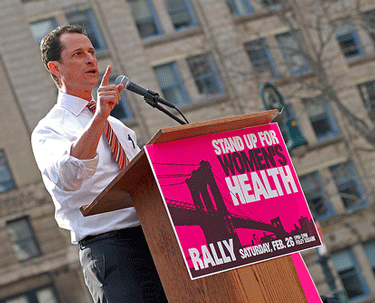
“My name is Anthony Weiner and I stand for women!â€
That’s not just a tailor-made caption for the indiscreet photo sent from the New York congressman’s Twitter account. Weiner proudly delivered that line twice during a rah-rah sisterhood speech to adoring fans at Planned Parenthood’s Stand Up for Women’s Health Rally in February. The only thing missing from his feminist cheerleading was a set of speculum-handled pom-poms.
But Weiner’s feminist rhetoric is far more tumid than the underwear-clad package he “can’t say with certitude†isn’t his — and just as susceptible to shrinkage. So here’s the cold water:
While the intended recipient of the lewd photo, 21-year-old Gennette Cordova, drowns in a raging media maelstrom, Anthony Weiner is using the only life preserver in sight as a hula hoop. Instead of ending the speculation about their relationship by asking law enforcement to investigate the alleged hacking of his Twitter account, Weiner spent the week tossing cagey Clintonian statements and erection puns to an increasingly suspicious press.
This is how Anthony Weiner stands for women.
Cordova and her family have been subjected to the kind of scrutiny, mockery, and even harassment normally reserved for public figures (and private citizens who vote Republican). Her candid party photos and off-the-cuff tweets are now front page news as bloggers and reporters rifle through cached social media accounts, hoping to shake out the single breadcrumb that might lead to a scoop on the young woman who denies “any inappropriate exchanges†with Weiner.
Continue reading at Frontpage Magazine.
Feminist Left Uses Child’s DIY Abortion by Pencil to Score Political Points
Originally published at David Horowitz’s NewsReal
_____________
30-year-old Michael Lisk told police he had sex with his 13-year-old neighbor “too many times to count.” He said the rapes, which began when the girl was just 12, were “like a marriage where you have sex all the time.”
Twelve months of sexual abuse culminated in a horrific incident last week when the pregnant child jammed a lead pencil through her cervix to trigger an abortion. After three days of increasing pain, Lisk “advised her to ‘push hard’ when she got a strong contraction.” She delivered a stillborn baby boy into the toilet, and on Lisk’s advice, placed the body in a plastic bag and threw it into the backyard. He took the bag and buried it in the woods by his home.
The following day the girl’s mother took her to the hospital where medical staff discovered evidence of a recent pregnancy and notified police. Days later, the girl was violated yet again when the feminist Left turned her into the latest poster child for the abortion rights movement. 
With absolutely no knowledge of this child’s situation, Jessica Wakeman at The Frisky insists parental consent laws are to blame for the gruesome home abortion.
One of the intentions behind these laws seems to be to let an adult know that their teenager is sexually active, presumably so they can intervene, or that their teenager has been raped, presumably so they can help them. In this case, those idealistic goals catastrophically failed.
It’s not hard to see how the fact that this 13-year-old girl needed parental consent for an abortion — which likely would have tipped them off to her 30-year-old friend/rapist — could have led her to do it herself.
Not that there’s any reason to believe this kid sought a medically-supervised abortion. And if she did? Any clinic near her home (and there are more than half a dozen within 30 miles) would have gleefully helped her stick it to the “anti-choicers” with a judicial bypass.
And heaven forfend a sexually active teen be forced to talk to her parents! Newsflash: most pregnant teens are afraid to tell their parents. That doesn’t mean parents don’t have a right to know.
Jill Filipovic at Feministe sees this child’s suffering as an opportunity to score points against pro-life groups:
[T]his girl obviously needed access to safe abortion care; if she had such access, she wouldn’t have had to self-induce abortion with a lead pencil. Abortion access would have lessened this tragedy by a significant degree. It’s shameful that, under the guise of caring about children and babies, anti-choice groups seek to limit abortion access for women and girls.
In Jill’s teen abortion fantasy, this child desperately wanted to terminate her pregnancy at the local Planned Parenthood, but the vast patriarchal conspiracy forced her to drive a sharpened piece of lead into her uterus instead. Cue the dream sequence sound effects. If only 13-year-olds could hit up the junior high vending machine for a dose of Mifepristone. Press 1 for Reese’s Pieces, press 2 for extra large cherry-flavored condoms, press 3 for abortifacient drugs. Why, abortion access like that would totally “have lessened this tragedy by a significant degree.”
There really are no words to fully address the depravity of this mindset.
The tragedy is that this child was betrayed, abused, or neglected by every single adult in her life. A child molester raped her more than a hundred times, impregnated her, and coached her through a do-it-yourself abortion by pencil. Reports suggest the fetus may have been “past 20 weeks gestation” but no one noticed or cared enough to help. And for three days after the self-induced abortion, no one realized she was ill.
A medically-supervised abortion might have lessened the trauma to the girl’s body, but to what “significant degree” would it diminish the tragedy? The life of a fetus that may have been past the point of viability was snuffed out in utero. A child who needed protection, guidance, and love got none of these things.
We may never know exactly why this kid risked her life to terminate her pregnancy. We may never know how many teachers, family members, and friends failed to keep her safe.
What we do know is that her decisions were influenced by a predator who wanted to destroy the evidence of his crime and ensure continued access to his vulnerable victim. Unrestricted access to abortion wouldn’t do a thing to change that, and neither will turning a child rape victim into a political football.
Please visit NewsReal to read more of my work or follow me on Twitter.
Defending The Right to Race-Based Abortions?

1921 diagram from the Eugenics Record Office
The virtue of hate crime legislation is a given on the Left. Criminals deserve stiffer punishments if they select victims based on race or sex, end of story.
But what if one of those criminals chose to abort a pregnancy based on the race or sex of the fetus? Oh, that would be a sacred right.
This is not hyperbole. Consider the depravity of this recent headline on Salon’s Broadsheet blog: Banning Race-Based Abortions is Wrong.
My body, my choice to abort based on race?
The Broadsheet piece by Tracy Clark-Flory is a reaction to the Prenatal Nondiscrimination Act, a proposed law that would outlaw abortion based on race, color, or sex in the state of Georgia.
The Prenatal Nondiscrimination Act would apply to abortion “the same standards of nondiscrimination†that govern employment, education, government and housing, said Georgia state Rep. Barry Loudermilk, a Republican who introduced the bill last month with bipartisan support.
If enacted, the bill would make it illegal to knowingly solicit, perform or accept funding for race- or sex-selected abortions.
So how does this translate into an assault on reproductive freedom? Clark-Flory explains:
Roger Evans, Planned Parenthood’s senior director for litigation and law, told me over the phone that his main objection is to “the notion that the government has a role in deciding what are fair reasons and unfair reasons for a woman to have an abortion.†First it’s race and sex — but what next?
Ah, yes, the slippery slope argument. First they come for our right to selectively abort female fetuses, and the next thing you know, it’ll be redheaded fetuses. Pretty soon we’ll have no right to abort eight-month-old fetuses that kick too much in the middle of the night.
Please visit NewsReal to read the rest.
Genius Idea of the Month: Reparations for Planned Parenthood
Did you know that Planned Parenthood was deeply wronged when CBS chose to air the pro-life Super Bowl ad featuring Tim Tebow and his mom? That’s what one editor at The Nation thinks.
From my article at NewsReal earlier this week:
Incensed by the completely innocuous Tim Tebow Super Bowl commercial, sports editor Dave Zirin blogged his fury at The Nation yesterday. He admits the ad was “about as vanilla as an Andy Williams Christmas Special.â€Â But it’s not the actual content of the ad that angers Zirin.
It’s the pesky free speech.
He’s infuriated that CBS would even consider offering a platform to Focus on the Family, an organization Zirin says has “shadowy connections to to open hate groups.†He believes allowing Focus on the Family to pay for “this kind of a mammoth public forum is an absolute disgrace.â€
So what’s his solution?
Zirin insists CBS execs should have to make amends for their complicity in advancing the pro-life agenda. “They should offer free commercial time to Planned Parenthood,†he proposes.
Please visit NewsReal to read the rest.
Keep Government Out of Health Care, Say … Liberals?
Want a clear indication that the federal government has no business getting into the health insurance industry? Look no further than the Stupak amendment, the measure that attached tight abortion funding restrictions to the House health care bill.
Democratic consultant Karen Finney called the Stupak amendment “an attack on our personal freedom and liberty as guaranteed by the constitution.” Rep. Barbara Lee (D-CA) said the amendment “attempts to dictate to women how to spend their own money.” And liberal columnist Michelle Goldberg lamented, “Health-insurance reform was supposed to end the sort of hideous cruelties our system inflicts on patients, not create them.”
To call Finney, Lee, and Goldberg tone deaf would be a grand understatement.
The only reason the abortion restrictions in the Stupak amendment are so intrusive is because health care reform is so intrusive. When we increase the role of government in health care, our freedoms and choices become more vulnerable to politics. Period.
Funding for every aspect of the doctor-patient relationship, every medical test and procedure, and every health care guideline becomes susceptible to pressure from special interest groups and moral scrutiny by taxpayers. If guys who can’t get it up have enough money to throw around, erectile dysfunction drugs make the cut. If taxpayers think acupuncturists are predatory quacks, no reimbursement for them. And after the reconciled bill is signed by the president, an unelected body will make these decisions for all of us.
Liberals cheered when President Obama appointed an executive pay czar, reasoning that companies like AIG have no right to determine pay packages if taxpayers are footing the bill. But somehow they missed the obvious lesson. There are always strings attached to government handouts.
Welcome, liberals, to the hazards of government subsidy. Either private insurance is restricted by health care reform, as with the Stupak provisions, or abortion receives some form of federal funding, thus changing the status quo. There’s no in between.
Objectionable restrictions abound when we seek increased state participation in our lives through regulation or subsidy. Just ask members of a United Methodist Church group that refused to make a beachfront pavilion available to a lesbian couple for a civil union ceremony. The group lost its state property tax exemption for failing to make the venue available to everyone on an equal basis. But that’s how it works: if you want state subsidies, you have to play by the state’s rules.
We’ve seen the impact on coverage in states that are experimenting with models of universal health care. In Massachusetts, legal immigrants no longer have state-subsidized coverage for dental, hospice, and skilled nursing care. And if you’re a Medicaid patient, prisoner, or public employee in Washington state, don’t expect your government to cough up the cash for knee arthroscopy for osteoarthritis – it’s one of several treatments no longer covered.
Speaker Nancy Pelosi has said that “the power of Congress to regulate health care is essentially unlimited.” Do liberals really believe that those regulations will exist to make their wildest dreams come true, now and forever?
When you invite the government to become more deeply involved in health care, you’re also inviting greater government interference in personal choice. Medical decisions become political decisions. That’s how it works, and it’s why philosophical opposition to the growth of government isn’t the crazy-eyed wingnuttery progressives make it out to be.
Proponents of liberal health care reform deliberately lured a bloodthirsty vampire over their thresholds, and now they’re shocked – SHOCKED – to find they have fangs buried deep in their necks. I’m not one to blame the victim, but it sounds like they might be getting exactly what they were asking for.
Two Thumbs Up, Social Cons!
Media reports have hailed Saturday’s passage of the Stupak amendment – a measure to impose tight restrictions on federally subsidized abortions – as a great triumph for pro-life Republicans.
What a crock.
The bipartisan vote was not a Republican coup. It was the final bit of lubrication needed to help the House health reform bill squeak through in a 220-215 vote. Without the passage of the Stupak amendment, Nancy Pelosi would not have had enough pro-life Democrats on board to pass her bill. So at best, the Stupak amendment was a Pyrrhic victory for pro-life Republicans. But more accurately, it was a demonstration that House Republicans are hopeless marks, skillfully manipulated into providing political cover for pro-life Democrats.
Even with the passage of the amendment, this pro-life “triumph” is destined to be short-lived should the bill make it to conference committee. More than 40 pro-choice Democrats are threatening to sink the final bill if it contains the abortion funding restrictions, and President Obama wants the amendment language nixed as well.  With weeks or months for House Majority Whip James Clyburn to bargain with pro-life Democrats, there’s a good chance he’ll gather enough votes to pass a final reconciled bill without the Stupak language. Few Democrats will want to block History in the Makingâ„¢.
Republicans had just one opportunity to derail Nancy Pelosi’s bill on Saturday: all they needed to do was hold their noses and vote “present” on the Stupak amendment. But only Rep. John Shadegg (R-AZ) had the stones to do so. The rest voted “aye” and now the Democrats have momentum, courtesy of the House GOP.
Votes in favor of the Stupak amendment amounted to nothing more than pro-life window dressing. No unborn lives will be saved by this vote, and in the end, all House Republicans will have to show for their “courage” are their pro-life bona fides. The vote was devoid of any true value to the pro-life cause, and if the reconciled bill passes, abortion will no longer be just a right women can choose to exercise; it will be an entitlement.
If a meaningless political gesture is enough to let these politicians sleep at night, it’s time to find new representatives.
-
Recent Posts
-
Read More From Jenn Q. Public at:
-
Recent Twitter Updates
-
Noteworthy Blogs
- A Traditional Life Lived
- Autographed Letter Signed
- Bookworm Room
- Cassy Fiano
- Chris is RIGHT
- David Horowitz's NewsReal Blog
- GayPatriot
- Hennessy’s View
- HoosierAccess
- Hot Air
- Instapundit
- Ironic Surrealism
- Jenny Erikson
- John Goodman’s Health Policy Blog
- Lisa Graas
- Melissa Clouthier
- Michelle Malkin
- Neo-Neocon
- Pink Elephant Pundit
- Racebusters
- Red Alerts
- Run & Gun
- Sister Toldjah
- Smart Girl Nation
- Snark & Boobs
- Tammy Bruce
- The Anchoress
- The DC Trawler with Jim Treacher
- The NeoSexist
- The New Agenda
- The Real Polichick
- The Sundries Shack
- The Truth in Black and Right
- what if?
