
Are You Using Fair Trade Condoms With Your Free-Range Hookers?
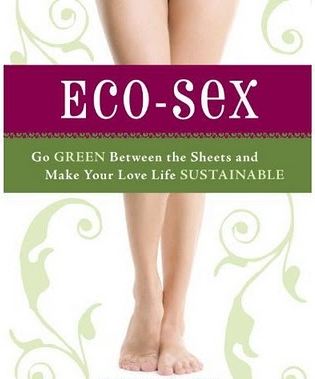
Originally published on December 10, 2010 at David Horowitz’s NewsReal
Like any socially conscious steward of Mother Earth, I have minimum standards when it comes to sex. I want my hookers sustainable, my porn carbon neutral, and my sex toys handcrafted from renewable resources.
I don’t care if you’re heterosexual or homosexual as long as you’re eco-sexual.
Tell me that’s not hawt! Admit it, you’re totally turned on right now.
Hello? Anyone?
Sure, you might think the sex industry is inherently sustainable. But you probably don’t realize how many reasons there are to feel guilty about what you’re doing. No, I’m not talking about the porn ‘n’ hookers, silly! It’s the environmental and social impact of sex work that should have your certified organic panties in a bunch. Not to worry, though. Givers like Green Futures deputy editor Anna Simpson are working feverishly to ensure your eco-sexually correct future looks a lot like this (hat tip: Pirate’s Cove):
Feel like watching the latest Fair Trade-certified porn film? The actors all enjoy decent pay, health insurance, and pensions. The carbon impact of the set lighting and travel is offset through investment in clean, efficient cookstoves sold at affordable prices to women in rural Africa.
Perhaps you’d prefer a spot of ethical lap-dancing? You can be sure the performers are all willing and well-paid: It’s certified by Care and Consent, the highly reputable international certification body for ethical sex. You tip generously, knowing that 50 percent of the profits are promised to the local women’s community center.
Or, maybe best of all, you opt for an evening in with your sweetheart. You’ve got everything you need: condoms made from rubber tapped sustainably in Brazil, hand-carved FSC-certified sex toys, and delicious Fair Trade dark chocolate body paint.
Tempted? You’re not alone.
Yes, the Left has discovered yet another segment of society to, er, penetrate: the sex industry.
Does your brothel use renewable energy to power the vibrating beds? Do the actors in that porn video donate to sad and hopeless progressive causes like Kathy Griffin’s comedy tours? And what about your condoms? Are they made from sustainably harvested fair trade latex processed by one-legged widows with gold-plated pensions in Sri Lanka? No?! Shame on you!
Okay, I think I got the whole eco-sexual activist thing out of my system now. I don’t have the stamina to keep it up. (Heh.)
As William Teach observed, “Sheesh, it’d be just like liberals to take all the fun out of sex, and replace it with Social and Environmental Justice.” Indeed.
But as absurd and mockable as this is, we’re not just dealing with killjoys and spoilsports. And we’re certainly not looking at genuine concern for the ethical treatment of sex industry employees, as Anna Simpson would have you believe. “Eco-sexuality” is yet another feelgood lefty scheme designed to give hipsters something to boast about as they sip humanely processed eco-tinis at the next vegan dinner party.
Anna Simpson and her ilk feign concern for the exploited workers of the sex industry, but they continue to order Asian escorts (read: human trafficking victims) from the seediest pages of The Village Voice. And Simpson is happy to continue enlarging her own carbon footprint by playing “Two Girls, One Cup” on an endless loop (hypothetically, of course) because hey, she wrote a whole article about how the actresses should be driving Priuses to and from the set.
Gosh, women are awfully lucky to have the Left on their side.
—–
Follow me on Twitter.
Norman Borlaug, International Hero
Via Reason comes the news that agronomist Norman Borlaug died yesterday at age 95. Borlaug was a great humanitarian, a Nobel Prize winner whose work to reduce hunger and malnutrition was unparalleled. And yet many have never heard of this man who developed high-yield agricultural techniques to save a billion people from the ravages of famine.
Just think about it for a moment. One billion lives saved.
Borlaug’s innovations in the breeding of wheat, rice, and corn enabled countries like Pakistan and India to become agriculturally self-sufficient. The Los Angeles Times reports:
In 1960, the world produced 692 million tons of grain for 2.2 billion people. By 1992, largely as a result of Borlaug’s pioneering techniques, it was producing 1.9 billion tons for 5.6 billion people — using only 1% more land.
But Borlaug faced stunning challenges in his efforts to address hunger in developing nations, particularly those in Africa. For decades, full-bellied, misanthropic environmentalists have campaigned against Borlaug’s use of genetic modification, inorganic fertilizers, and controlled irrigation to improve crop productivity. He responded to the criticism by saying, “It appears that many of the most rabid crop biotech opponents are driven more by a hate of capitalism and globalization than by the actual safety of transgenic plants.”
Environmentalists also condemned his work for allegedly poisoning the water supply, threatening biodiversity, and contributing to overpopulation of the planet. In the 1980s, buckling under pressure from environmental lobbyists, the International Maize and Wheat Center where Borlaug conducted much of his groundbreaking work lost the support of the World Bank and the Rockefeller and Ford Foundations. Borlaug observed:
Some of the environmental lobbyists of the Western nations are the salt of the earth, but many of them are elitists. They’ve never experienced the physical sensation of hunger. They do their lobbying from comfortable office suites in Washington or Brussels. If they lived just one month amid the misery of the developing world, as I have for fifty years, they’d be crying out for tractors and fertilizer and irrigation canals and be outraged that fashionable elitists back home were trying to deny them these things.
Ultimately, Borlaug was able to return to his efforts to bring high-yield farming techniques to several African nations with the assistance of Ryoichi Sasakawa, Japanese fascist turned philanthropist, and former United States president Jimmy Carter. Today, the fruits of his research can be seen in the prevalence of the high-yield dwarf wheat that helps much of the world’s population live beyond the grip of starvation.
There are still more than 800 million undernourished people in the world. Norman Borlaug’s legacy can change that, but only if we make it a priority.
Update: Common ground for the left and right? Far left commenter Eclectic Radical is also honoring Norman Borlaug. (Yes, he insists on throwing a “David Duke:conservatives as misanthropic environmentalists:liberals” analogy into the comments below, but, you know, baby steps.)
Dreaming of a Green Christmas

Looks like Santa’s dreaming of a green Christmas this year, or so one “author” would have your kids believe. Apparently he’s at his workshop with the elves raiding his stash of last year’s hoarded wrapping paper in preparation for regifting the old toys he’ll be refurbishing just for you.
“They arrived back at the North Pole and Santa had a grand idea,” the book reads. “He leaned in toward Swift [the head elf] and told him his new plan. ‘We will collect all of the old toys, Swift, and make them new again. We will reuse last year’s wrapping paper. And we will harness the great North Pole wind to help power up the toy shop.’”
Hey Santa: thanks, but no thanks. I’ll stick with the slightly more traditional lump of coal in my stocking. Or will that be replaced with vials of ethanol?
I hope the new and improved eco-Santa won’t be too upset with 4-year-old cancer patient Hannah Garman for asking for a ton of Christmas cards this year. Using all that paper to fulfill a dying child’s wish might not fit into his green agenda.
-
Recent Posts
-
Read More From Jenn Q. Public at:
-
Recent Twitter Updates
-
Noteworthy Blogs
- A Traditional Life Lived
- Autographed Letter Signed
- Bookworm Room
- Cassy Fiano
- Chris is RIGHT
- David Horowitz's NewsReal Blog
- GayPatriot
- Hennessy’s View
- HoosierAccess
- Hot Air
- Instapundit
- Ironic Surrealism
- Jenny Erikson
- John Goodman’s Health Policy Blog
- Lisa Graas
- Melissa Clouthier
- Michelle Malkin
- Neo-Neocon
- Pink Elephant Pundit
- Racebusters
- Red Alerts
- Run & Gun
- Sister Toldjah
- Smart Girl Nation
- Snark & Boobs
- Tammy Bruce
- The Anchoress
- The DC Trawler with Jim Treacher
- The NeoSexist
- The New Agenda
- The Real Polichick
- The Sundries Shack
- The Truth in Black and Right
- what if?
